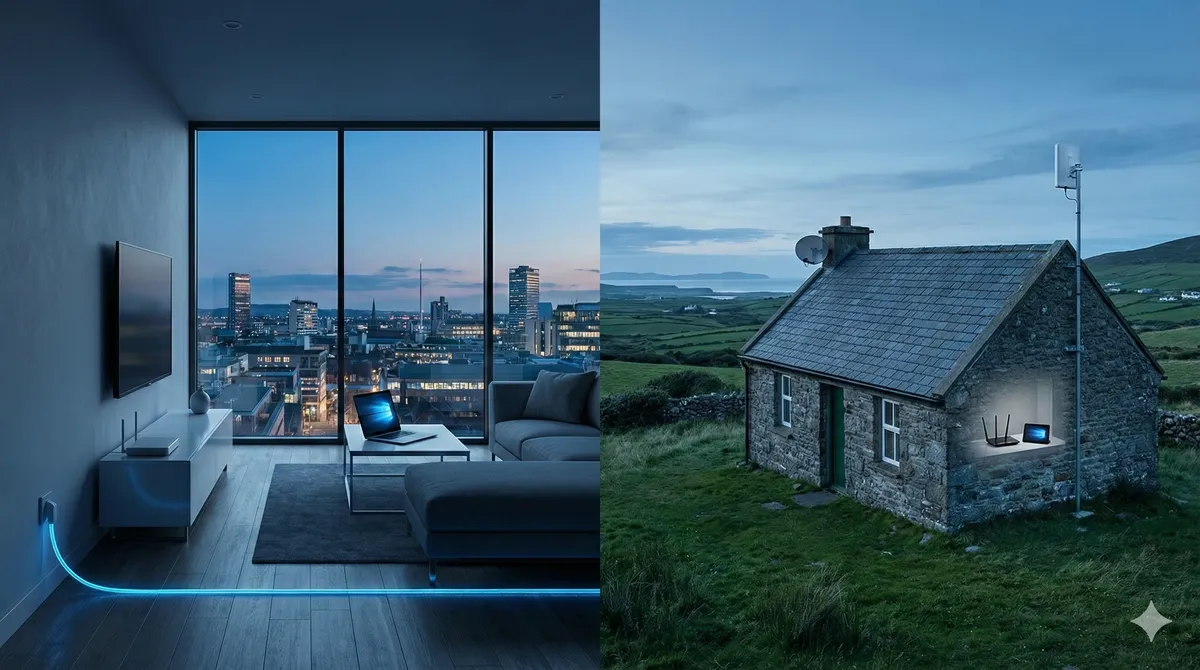
If you are choosing broadband in Ireland, the wrong decision usually happens when fibre, 5G, and Starlink are compared using headline claims instead of what is actually available and usable at the address.
If you need help in Dublin or surrounding areas, the closest starting point is internet and Wi-Fi troubleshooting, and the next most relevant path is Starlink installation and setup.
How to make an informed choice (and avoid buying the wrong package)
Before any speed claims or sales calls, focus on this:
- What is truly available at your exact Eircode.
- What speed and stability you actually need in daily life.
- What trade-offs you are willing to accept (price, contract length, install delay, consistency).
Sales teams sell plans. You need to buy what fits your home.
The numbers below help you do that with facts, not just marketing.
Quick ranking: urban vs rural
Here is the practical ranking most people can use as a starting point.
Urban areas (typical order)
- FTTH fibre (Open eir / SIRO / NBI where available)
- Cable / upgraded Virgin Media network
- FTTC / VDSL (“fibre to the cabinet”, copper to your home)
- 5G home broadband
- 4G home broadband / fixed wireless
- Starlink (usually not first choice in dense urban unless fixed options are poor)
- DSL (legacy fallback)
Rural areas (typical order)
- FTTH fibre (NBI/Open eir/SIRO) if available at your Eircode
- Starlink (with clear sky view)
- FTTC / VDSL (if you are close to the cabinet and line quality is good)
- 5G home broadband (if you have strong, consistent signal)
- 4G home broadband / fixed wireless
- DSL
The key point: in rural Ireland, Starlink often moves much higher up the list because fixed options are not always ready yet.
Option-by-option: what each type is really like
1) FTTH fibre (best overall when available)
This is fibre all the way to your home. It is still the strongest all-round option for most homes and businesses.
Why it ranks first:
- Stable performance
- Low latency
- Better consistency at busy hours
- Strong long-term value
What to expect:
- Usually excellent for remote work, gaming, streaming, and heavy cloud use
- Handles lots of devices better than wireless-only options
- Fewer surprises once installed properly
Things to watch:
- Availability can still lag by address, especially for very new builds
- Installation can be delayed by ducting/civils/address database updates
Useful context:
- NBI states minimum speeds of 500 Mbps in intervention areas from rollout launch.
- Open eir and SIRO both continue major expansion across the country.
If FTTH is available at your Eircode, it is usually the right first choice.
After install, pair it with Wi-Fi installation and setup so the speed reaches every key room.
2) Cable / upgraded fibre-coax (very strong in many urban areas)
In Ireland this is mainly Virgin Media footprint plus wholesale expansions.
Why it ranks high:
- Widely available in many towns/cities
- High download speeds
- Good fit for streaming-heavy homes
What to expect:
- Great results for most households
- Speeds can be very fast, with gigabit options widely marketed
Things to watch:
- Upload performance can vary by area/package
- Performance consistency depends on local segment load and in-home setup
Useful context:
- Virgin Media states 1Gb services across 1 million premises and 2Gb in upgraded areas.
- It also expanded reach through wholesale/NBI access deals.
In urban/suburban Ireland, cable can be an excellent choice when FTTH is not available or priced well.
3) FTTC / VDSL (better than DSL, but not full fibre)
This is where a lot of people get confused.
FTTC is often sold as “fibre broadband,” but it is not the same as FTTH.
With FTTC, fibre goes from the exchange to the street cabinet, then the last stretch to your house is still copper (VDSL). Openreach describes this exact setup in its FTTC explanation.
That copper last stretch is the catch.
The closer you are to the cabinet, the better FTTC usually performs. The farther away you are, the more speed you lose. So FTTC can be decent on one road and disappointing nearby.
And a quick myth check: people often blame “distance from the exchange” for everything. For FTTC, cabinet distance is usually the bigger factor. Exchange distance is more of an old ADSL problem.
Why FTTC can still be useful:
- Often better than legacy DSL
- Can be a decent middle ground while waiting for FTTH
- Widely available in many areas
Things to watch:
- Performance is hit-or-miss because of copper quality and length
- Uploads are usually much weaker than FTTH
- Not as future-proof as full fibre
If FTTH is available, choose FTTH. If it is not, FTTC can still be a workable stopgap.
4) 5G home broadband (great in some places, average in others)
5G home broadband is fixed internet delivered over mobile network.
Why people choose it:
- Quick setup
- No fibre install delays
- Can be very good where signal is strong
What to expect:
- In a strong-coverage location, it can feel very fast
- Works well for many households doing normal work and streaming
Things to watch:
- Performance can swing by time of day, local congestion, terrain, and indoor signal
- “Coverage” and “good indoor performance” are not the same thing
Useful context:
- eir advertises 99% 5G population coverage and 99% 4G coverage on its mobile broadband page.
- Vodafone says its 5G is live in selected areas across all 26 counties.
So 5G can be excellent, but check by exact address and test if possible before fully committing.
5) Starlink (major rural fallback, sometimes primary choice)
Starlink changed the rural broadband conversation because it bypasses local fixed infrastructure delays.
Why it ranks high in rural:
- Works in places with weak or delayed fixed rollout
- Good speeds for many real-world home use cases
- Fast path to “usable now” internet
If you go this route, proper mounting and integration matter. See Starlink installation and network integration.
What to expect:
- Usually a big step up from poor DSL
- Often better consistency than weak mobile broadband in difficult terrain
Things to watch:
- Needs a clear view of the sky
- Performance can drop with obstructions or poor install position
- Weather, placement, and local obstructions matter
Useful context:
- Starlink says setup requires a clear sky view.
In cities, Starlink is usually not the first pick if you have strong fixed options. In rural areas, it can be the practical answer while waiting for fibre.
For a real-world example of that trade-off, read How Starlink Changed Rural Internet in Ireland.
6) 4G home broadband / fixed wireless (useful fallback)
This is still a valid option where fibre and strong 5G are not available.
Why people choose it:
- Fast to deploy
- Can be enough for light-to-moderate households
- Often cheaper entry point
What to expect:
- Fine for browsing, normal streaming, and light remote work
- More variable than fixed fibre
Things to watch:
- Evening slowdown can happen
- Speeds depend heavily on local mast load and signal quality
- External antennas and proper router placement can make a big difference
Bottom line: very useful as a fallback, less ideal as a long-term heavy-use solution.
7) DSL (legacy option, last resort where possible)
DSL is still present in some areas, but it is a legacy technology.
Useful context:
- Open eir bitstream references “up to 24 Mbps down / 768 Kbps up” for ADSL-managed backhaul.
What to expect:
- Basic browsing and low-demand use
- Limited upload and lower headroom for modern multi-device homes
If you are on DSL and can move to FTTH, strong cable, good FTTC, strong 5G, or Starlink, that is usually worth doing.
What this means in real life
If you are in an urban area:
- Check FTTH first.
- If not available, check cable.
- If both are unavailable, check FTTC next and ask for expected speed at your exact line.
- Then check 5G with an address-level test.
If you are in a rural area:
- Check NBI/Open eir/SIRO availability first.
- If not ready yet, check whether FTTC is available and what speed estimate you get.
- Then compare Starlink and 5G at your exact location.
- Keep DSL as a temporary stopgap, not a long-term plan.
And always test Wi-Fi inside your home after install. Many “broadband problems” are actually in-home Wi-Fi layout issues.
A short checklist before you sign any contract
Use this before choosing:
- Check availability with your exact Eircode on provider checkers.
- Ask for realistic speed expectations for your specific address.
- Confirm contract length, early exit fees, and annual price changes.
- Ask whether install delays are possible (new build, ducting, civils, address records).
- For 4G/5G: check indoor signal in the rooms you actually use.
- For Starlink: test obstruction with the app before ordering.
- Plan in-home Wi-Fi properly (one router rarely covers every room well in modern homes).
Do those seven steps and you avoid most bad broadband decisions.
Bottom line
Not all broadband types perform the same in Ireland. This guide ranks the main options for urban and rural areas, with realistic expectations, pros, and trade-offs.
If you want help with this in Dublin or surrounding areas, start with internet and Wi-Fi troubleshooting, Starlink installation and setup, or book a consultation.